Quick decision table
Practical steps
- Confirm cargo is suitable for ocean and inventory timing allows it.
- Organize multi-supplier consolidation files and carton data.
- Confirm LCL, FCL, or FBA first-leg plan.
- Review export and US clearance documents before departure.
- Ship by sailing schedule and follow arrival/clearance milestones.
- After release, arrange truck or courier delivery.
What can change the answer
- Sailing schedule and port congestion
- Peak-season capacity
- Timely ISF and clearance documents
- Destination appointment, pallet, liftgate, or receiving-window rules
How Qianding can help
- Yiwu and East China supplier consolidation
- Ocean LCL/FCL coordination
- US clearance and duty-handling coordination
- FBA, 3PL, and commercial delivery connection
What the customer should prepare
- Plan inventory early
- Provide complete carton data, invoice, and packing list
- Confirm US warehouse receiving rules
- Accept possible ocean-shipping disruptions
ISF 10+2 data before loading
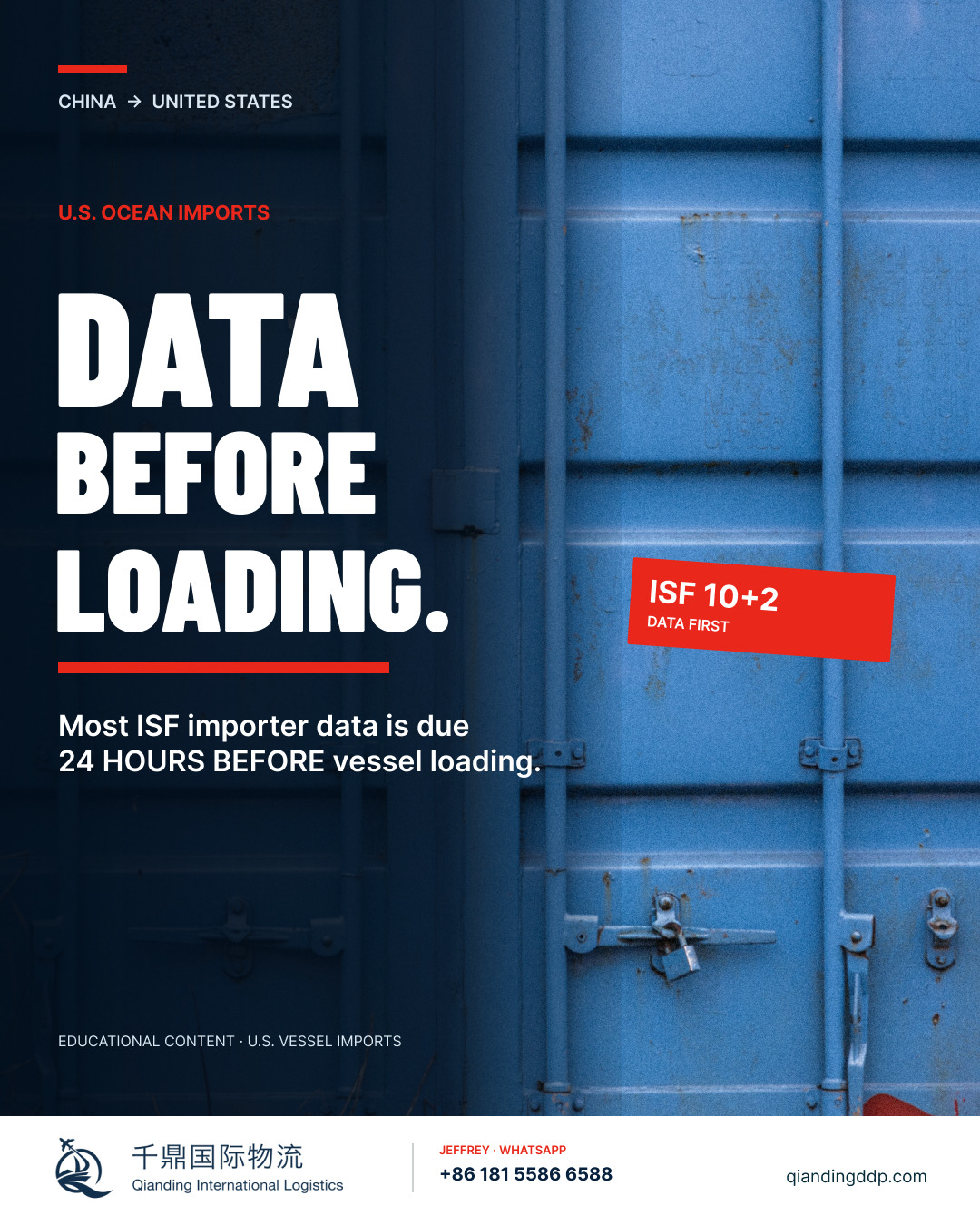
For cargo arriving in the United States by vessel, U.S. Customs and Border Protection requires an Importer Security Filing, commonly called ISF 10+2. Most importer data elements are due no later than 24 hours before the cargo is loaded aboard the vessel at the foreign port. This timing makes ISF preparation a pre-loading task, not an arrival-day task.
Before cargo leaves China, confirm who is responsible for the filing, who will supply each data element, and when the information will be ready. Do not assume that the freight booking itself confirms an ISF has been filed.
What information is included in the importer filing
CBP identifies ten importer data elements. They cover the parties and places involved in the transaction, identification numbers, origin and classification information, and where the container is stuffed and consolidated.
A practical preloading handoff
- Name the filing party. Ask the importer, broker or other authorized filing party who will submit the ISF and how acceptance or exceptions will be communicated.
- Set a data deadline. Work backward from the planned vessel loading time. Allow time to resolve missing or inconsistent names, addresses, identifiers and product information.
- Match the shipment records. Compare the ISF data with the commercial invoice, packing list, booking and the actual cargo being loaded.
- Keep the status with the shipment file. Record the responsible party and filing status so the operations team does not confuse a booking confirmation with an ISF confirmation.
Start the conversation with five details
- Cargo name and product use
- Supplier or pickup city in China
- Carton count, packed weight and outer dimensions
- United States destination, ZIP code or FBA warehouse code
- Cargo-ready date and planned ocean-shipping window
Qianding can discuss the freight plan and help identify which shipment information is still needed. This page does not state that Qianding files ISF for every shipment and is not customs-compliance advice. Filing responsibility and requirements must be confirmed for the actual transaction.
Choosing between LCL and FCL
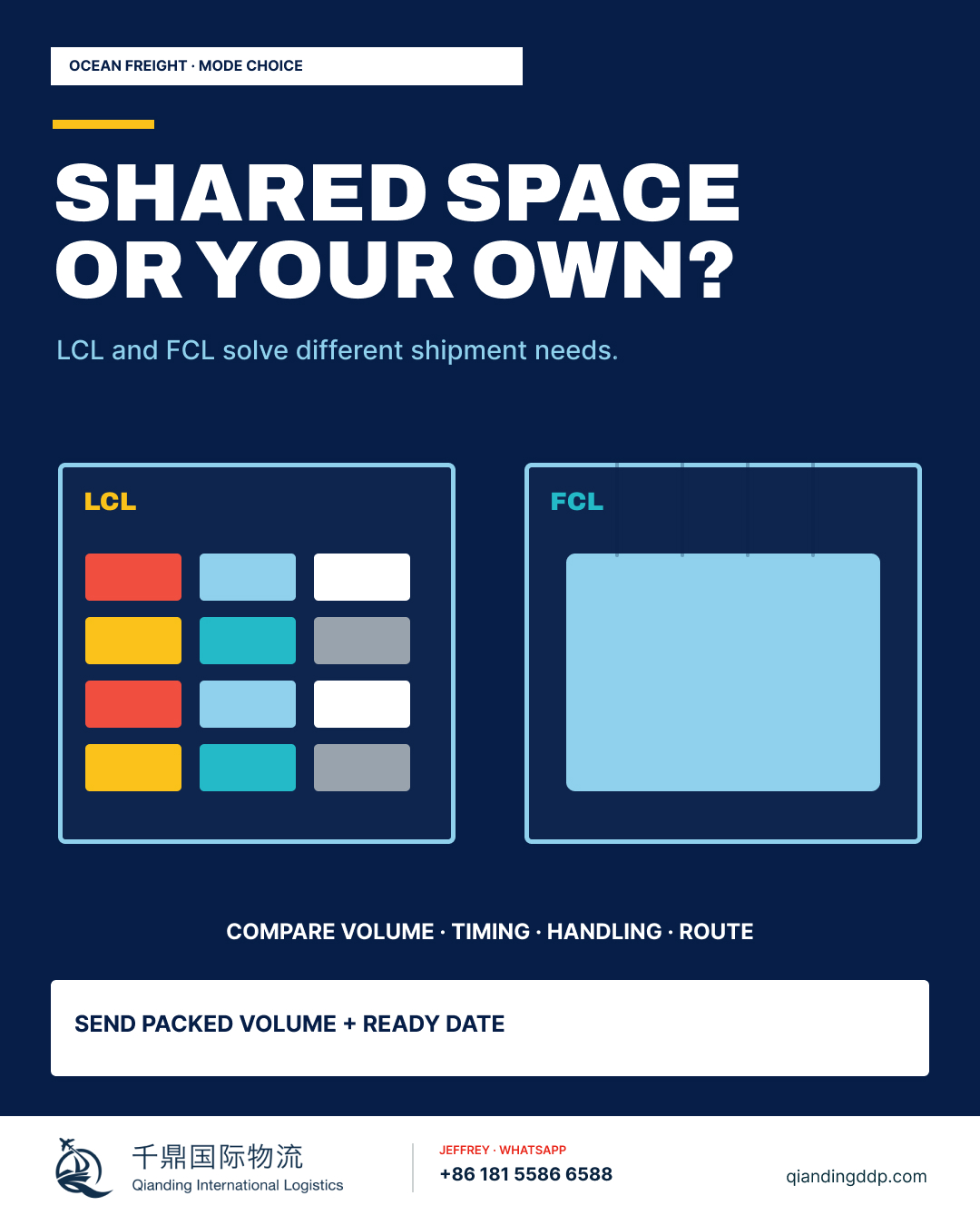
LCL uses shared container space; FCL uses a container reserved for one shipper. The better choice is not set by one universal CBM cutoff. Compare packed volume and weight, cargo-ready date, route, handling sensitivity, loading stability, destination requirements and the complete landed quote.
Send actual packed volume and the ready date first. Qianding can compare the available LCL and FCL plans for the current China-to-USA shipment and state the assumptions in the written quotation.
Operational sample
Operational sample: 6 CBM of home-building products to a California commercial warehouse is consolidated in Yiwu, measured, quoted for ocean DDP, checked for receiving window and customs documents, then booked.
FAQ
Is ocean DDP good for small parcels?
It can be reviewed, but urgent or small shipments should be compared with air or express options.
How do I choose LCL or FCL?
Use volume, weight, cargo value, delivery timing, and loading stability to decide.
Can ocean clearance affect transit time?
Yes. Arrival, filing, exam, release, and final delivery all affect arrival time.
What is needed for FBA ocean DDP?
FBA code, labels, carton data, appointment/delivery requirements, and cargo documents.
Sources
- U.S. Customs and Border Protection: Basic Importing and Exporting
- CBP: Importer Security Filing 10+2 Program
- CBP: Importer Security Filing and Additional Carrier Requirements
- International Trade Administration: Know Your Incoterms
- Maersk: Understanding Ocean Freight
This guide is for shipment preparation and quote discussion. It is not legal, tax, or customs-compliance advice. The final plan depends on actual cargo data, US regulatory requirements, current route availability, and the written quotation.